Sustainable hosting and decorating
Deck the halls not the cupboards
4 minute read
Let’s strip it back, figuratively and literally! If we think about hosting: what is really important? Do we really need matching plates, new decorations and a cracker that will be forgotten two minutes later to create a memorable celebration? Or is it the people around the table, the food we share and the conversations we have that matter most?
APDO member Anne Fennell helps run APDO’s Sustainability Special Interest Group (SIG) for our members. Here Anne shares ideas from the group’s recent discussion about enjoying the festive season in a sustainable way.
Look At What You Already Have
Whatever we celebrate from now until the end of the year, let’s reframe these occasions. We can start by looking inward: what do we already have in our homes? Most likely, we already have enough. If we don’t, perhaps we could ask a neighbour or friend to lend us what we need? After that, we can think about the circular economy, such as using local Freecycle sites, nearby charity shops and small, family-run businesses.
Share The Food, Share The Load
Food waste is a particular concern at this time of year, when the pressure to provide plenty can lead us to buy and cook far more than we need. Research reported by Too Good To Go in 2024 suggested that 50% of food bought for the festive break often goes uneaten. Meanwhile, the Environmental Protection Agency of Ireland estimates that Irish households generated approximately 18,000 tonnes of household food waste every month in 2024.
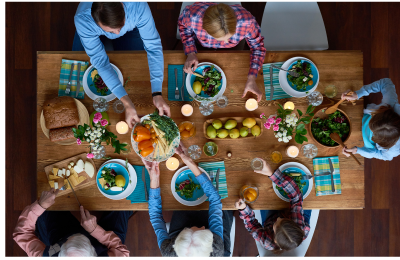
Cooking for volumes of guests can overwhelm the most capable of hosts. ‘Divide and conquer’ and ‘work smarter not harder’ are phrases my children quote and frankly they’re not wrong! Asking guests to bring a dish instead of a gift can kill two birds with one stone. They feel they have given us something without having to think of a gift we may not use and, also, they contribute to the food for the occasion. Potluck is so much fun and the variety of tastes can elevate an event. There is strength in the collective and we need to capitalise on this during the festive period.
We could also think about meals that can be enjoyed on the day and then easily repurposed into a slightly different version in the next few days. Sending leftovers home with guests or popping them into an elderly neighbour living alone, if appropriate, cuts out waste and can be so helpful. Before donating food beyond family and friends, check with the local homeless shelter or food-support service to see whether it can accept donations and what food-safety requirements apply.
Decorate With Meaning, Not More Stuff
After food waste, decorations are another area to consider. The most sustainable festive decoration is the one we don’t buy. The Ellen MacArthur Foundation uses the idea of ‘emotional durability’ alongside physical durability. Essentially this means designing or choosing things that remain desirable and relevant for us to use for longer. This also means looking at our sentimental collection of decorations. The ones we have inherited, were made by our children or bought during shared holiday experiences.
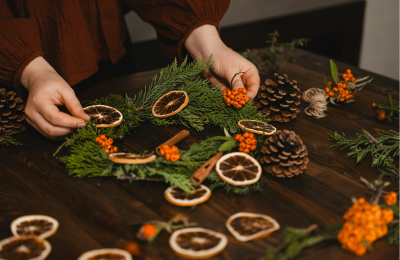
Turning to nature for decorations can be sustainable and sensory, too. There is nothing prettier than a table with pine cones, eucalyptus and dried oranges for visual impact and refreshing scent. Collecting from nature is about finding fallen items or else using what we have already in our houses. Fabric napkins and table toppers can be used to avoid disposable ones. If they are not festive in design, we can simply add a sprig of greenery and some berries to elevate them into festive flourish.
When it comes to Christmas trees, millions of real trees are disposed of in Britain each year. This makes it worth considering the environmental impact of our choices, including whether a reusable artificial tree is right for us. Its impact depends partly on the materials used and how many years it remains in use. Using it year after year spreads that impact over a longer period. We could also create a hanging feature for decorations that doesn’t involve any type of tree. It could be simple in design and sustainable in materials used.
With decorations comes light and we can also overindulge here. We can be tempted to drench our homes in fairy lights. Sometimes less is more and while the phrase ‘lit up like a Christmas tree’ is famous, we do not have to cover every surface in our homes with lighting. Perhaps we can avoid energy waste by using LED bulbs, timer plugs and solar powered outdoor lighting. Candles create atmosphere and can be placed in empty wine bottles, cleaned out jam jars or on old saucers.
Give Thoughtfully And Wrap Creatively

When the lights are on, we want to gift. It is worth having a conversation about gifting too! Who needs another gift they don’t use, want or love? Much of our work as professional organisers involves helping clients reframe how they feel about letting go of unwanted gifts. Shared experiences, local activities or just a voucher for a coffee in the local bakery can be more meaningful and practical. If we feel compelled to buy gifts, we can look for durable, repairable, reusable or responsibly-made products, rather than assuming that every local product has a low environmental impact.
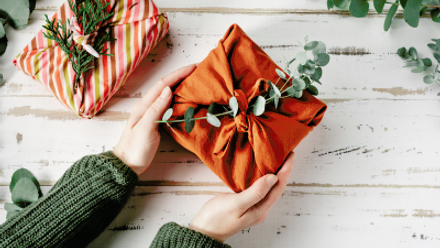
It is estimated that 227,000 miles of wrapping paper are used in the UK each year. Wrapping these gifts can be done simply in old newspaper with colourful ribbon that can be reused or by using the technique of furoshiki, where any fabric becomes the wrapping.
So, to wrap it up sustainably (see what I did there!) it is about small changes year on year. If we make these then the eco-ripple effect grows. We also normalise how to ‘do the festivities’ and potentially unburden family and friends too. Perhaps the best tradition we can pass on is the understanding that a celebration doesn't need to be bigger, newer or more elaborate each year. It simply needs to bring us together.
APDO members would love to support you with your festive planning - search our member's directory to find your professional organiser today.
Anne Fennell is the owner of Kindred Sorting and is an International member of the APDO community, living in Dublin, Ireland. She supports families who are clearing inherited homes due to bereavement, when decision making can be so overwhelming that people quickly process items they may regret in the future.
Kindred Sorting is a business born out of a lived experience, from when her parents died ten days apart and she had to clear their life’s belongings out of their apartment to get it market ready. She understands first hand the emotional and physical burden this carries.
With sustainability high on her priority list, she employs innovative upcycling practices, collaborates with local charities and uses craftspeople to create purposeful and meaningful keepsakes while reducing the burden to landfill.
Anne helps run APDO’s Sustainability Special Interest Group (SIG) along with Karen Woodman (Jumpstart Coaching and Organising), Kate Yiannacou (Tidy Happy Calm Decluttering) and Christina Ferraz (CHF Decluttering)