Where does our waste really go?
2 minute read
As professional organisers, we often help clients make thoughtful decisions about what stays in their homes and what leaves. But responsible organising doesn’t end at the front door: it extends to understanding where those unwanted items actually go.
APDO member, Victoria Fearnley, recently went behind the scenes on an exclusive tour of a waste management facility near Heathrow, operated by Grundon. What she discovered offers valuable insight into why reducing, reusing and recycling correctly matters more than ever.
First Stop: Recycling Sorting
At the Materials Recovery Facility (MRF), mixed recycling from households and businesses is sorted using a combination of advanced machinery and manual expertise. Even with today’s technology, human oversight remains essential. As many as 20 people stand alongside conveyor belts removing items that cannot be recycled, ensuring materials are processed efficiently and accurately.
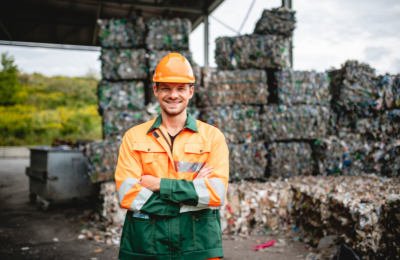
Paper, cardboard, plastic bottles, cans and glass are separated into individual material streams. Magnets extract metals, while optical detection systems use targeted air jets to direct plastics and paper into different channels.
The end result? Clean, compacted bales of materials ready to be sent to manufacturers who transform them into new products.
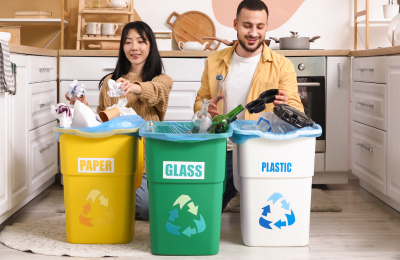
Seeing this process first-hand highlights just how important correct sorting at home really is. Contamination — placing the wrong item in the wrong bin — can slow the system and reduce the volume that can ultimately be recycled. As recycling rules vary by local authority, it is always worth checking your council’s guidance to ensure you are recycling correctly.
What Happens to General Waste?
Not everything can be recycled. For residual waste, Victoria visited Grundon’s Energy from Waste facility.
Here, non-recyclable rubbish is delivered into large bunkers before being fed into high-temperature furnaces. The heat generated produces steam, which drives turbines to create electricity. Rather than being sent to landfill, residual waste at this location is converted into energy that powers the facility and supplies surplus electricity to the National Grid.
At the end of the process, metals are extracted and sent for recycling. The remaining ash is processed and incorporated into construction materials such as breeze blocks and road surfacing. Even at this final stage, efforts are made to recover value from what would otherwise be discarded.
Not a Perfect Solution
We cannot discuss waste disposal without acknowledging environmental impact. Energy from Waste facilities do produce carbon dioxide, a greenhouse gas that contributes to climate change. However, landfill sites generate methane, which has a significantly greater warming effect.
While Energy from Waste is not a perfect solution, it is currently considered a preferable alternative to landfill for non-recyclable waste. The bigger picture remains clear: reducing waste in the first place is always the most sustainable option.
A Wider Perspective
It is easy to feel disconnected from the waste system. Once the bin lorry drives away, the story seems to end. Yet behind the scenes, a vast infrastructure of people, machinery and innovation is working to recover value from what we throw away every single day.
For professional organisers, this reinforces an important principle: our work is not just about creating calm, functional spaces - it is also about encouraging mindful consumption and responsible disposal.
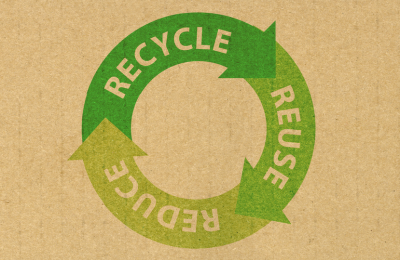
Victoria’s visit highlighted three key messages:
- Reduce first – The most sustainable item is the one that never becomes waste.
- Reuse where possible – Donations, resale and repair extend a product’s life.
- Recycle correctly – Clean, properly sorted materials have the best chance of becoming something new.
Victoria described her experience as both fascinating and reassuring - a reminder that while the system is not flawless, significant effort and innovation go into reducing landfill and recovering value from what we discard.