The Surprising Role of Professional Organisers in Global Recycling
Global Recycling Day (18th March) encourages us to consider what happens after items are discarded. Think recycling bins, collection systems and donation platforms. In reality, however, the story begins much earlier — in our homes. APDO member Sheena Taylor shares her thoughts on ways to navigate complex reycling systems, and how the support of a Professional Declutterer and Organiser alongside you can ease and enhance the process.
Long before an item reaches a recycling centre, it has been purchased, stored, forgotten, rediscovered and finally reviewed. Within this everyday decision-making process sits an often-overlooked group of professionals who can influence the journey of household goods in practical and meaningful ways.
This dedicated group help individuals consciously manage their belongings, adopt more sustainable habits and ultimately prevent thousands of perfectly useable items from ending up in landfill. These passionate recyclers are Professional Declutters and Organisers - and every day we play a key, and yet undervalued, role in global recycling in many ways.
Navigating Complex Recycling Systems
Recycling processes are complex. Electronics, batteries, textiles, paints and certain plastics require specialist handling. Local authority guidance varies and so misunderstandings are common.
One significant challenge is “wishcycling” — placing non-recyclable items in recycling bins in the hope they will be recycled. Unbeknownst to the well-intentioned recycler, this creates a ‘contamination’ in the recycling stream that can increase the number of items ending up in landfill.
As professional organisers, we are well-placed to reduce this risk. Through up-to-date local knowledge, and providing clear guidance, we support clients to determine what goes into general waste and household recycling, and what can be sold or donated thereby contributing to more items being re-used or effectively recycled.
Extending the Life of Possessions
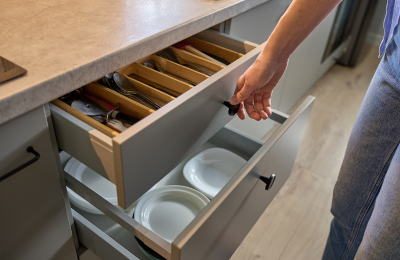
Cluttered storage often shortens the lifespan of belongings. Overcrowded boxes, drawers, cupboards and other household areas lead to damaged clothing, broken items and forgotten purchases. When possessions are inaccessible or poorly stored, they are less likely to be taken care of or repaired when needed.
Thoughtful organisation protects household items from becoming lost or broken. Organising systems make items visible and easier to access and to care for. This increases the likelihood that we know what we own and use it, as well as considering repairing items before replacing them and keeping the items in better condition for longer. By facilitating this process, professional organisers are supporting the lifespan of household products.
Reducing Purchasing Duplicates
A common situation of disorganisation in the home is the unintentional over-purchasing of items that are forgotten about or cannot be found. Many people frequently buy duplicates of items as and when they are needed without being aware that the products are already sitting in their homes.
Professional organisers can support clients to prevent this from happening. By creating clear, accessible storage systems and the realistic boundaries set by the size of the storage, we can help our clients to see and use what they already have. Being able to see items reduces the chance of buying things again and saves money, while also lowering the demand for additional production, packaging and transportation.
The support of a professional organiser can interrupt this constant cycle of buying, storing, forgetting and re-buying and encourages more intentional buying habits that are based on knowing what we have.
Facilitating Responsible Redistribution

Decluttering does not need to mean disposal. One key contribution that we as professional organisers can make is enabling the responsible redirection of unwanted items.
Through established relationships with local charities, community groups, reuse organisations and specialist recycling services, we can match items to appropriate outlets. This reduces the burden on charity shops, many of which face challenges due to unsuitable or excessive contributions.
By understanding which organisations accept specific items and in what condition, a professional organiser can improve the likelihood that goods genuinely are reused.
Taking this balanced and informed approach, professional organisers can support both community causes and environmental responsibility.
Influencing Future Behaviour
Perhaps the most significant impact of professional organising lies in the influence on future habits. Decluttering sessions often reveal patterns of buying beyond financial means, impulse purchasing or the accumulation of items due to purchasing duplicates.
Through respectful conversation and practical strategies, organisers can support you to reflect on these patterns. Maintenance sessions, clear storage limits and simple guidelines such as “one in, one out” can prevent repeated cycles of accumulation.
By addressing clutter at its origin — purchasing decisions and storage capacity — we can reduce the volume of future waste entering the system. Behavioural change in the home leads to larger, planet-wide sustainability goals.
The Professional Responsibility
We believe that professional organisers can have a profound influence on both household habits and community waste streams. That is why including sustainability knowledge as part of an organiser’s training is important. Local recycling knowledge, transparency with clients about practical and reliable disposal routes and the ability to build networks with local repair cafés, charities, hobby groups and recycling organisations are key skills for allowing these professional declutterers to have an impact on recycling.
Knowing the positive environmental ripple effect that this causes is exactly why APDO (the Association of Professional Declutterers and Organisers) offers a Sustainability Interest Group for its members so that this work is already extending its reach.
Recognising the Role of Professional Organisers
On Global Recycling Day, attention rightly focuses on saving materials. However, every recycling decision begins in our homes. The destination of items depends largely on the household habits in place.
Professional organisers operate within that decision-making space every day.
We can help to extend the lifespan of items, reduce the amount of “wishcycled” products, support clients to limit purchasing duplicate items, and play an active role in redistributing unwanted items to appreciative organisations. These actions help keep valuable resources in circulation for longer, reduce landfill waste and strengthen recycling efforts in ways that are often unseen but collectively significant.
We believe that professional organisers are not on the sidelines of sustainability — we are part of the system. Through our practical actions, informed guidance and ethical practices, we are active participants in a more eco-conscious world.
If you’d like to adopt a more sustainable approach to decluttering and organising then take a look at APDO’s Find An Organiser page – we’d love to help you to get organised sustainably.