
Visual noise: why your home feels tiring even when it's tidy
3 minute read
You walk into your home after a long day.
Nothing is particularly messy. The washing up has been done, the floors are clear and everything is more or less in its place.
So why does the room still feel... busy?
APDO member, Maraki Thomas reveals the answer could be visual noise, the invisible clutter we rarely talk about.
Unlike physical clutter, visual noise isn't about how much you own. It's about how much your eyes and brain have to process every time you walk into a room.
Open shelves full of different packaging. A collection of charging cables. Children's artwork covering every surface. Shoes by the door. Labels facing in every direction. Piles of post waiting to be dealt with. Decorative objects that have gradually multiplied over the years.
Individually, they're harmless.
Together, they're all quietly competing for your attention.

Your brain is working harder than you think
Every object in your line of sight asks your brain a question:
"Do I need to pay attention to this?"
Most of the time, the answer is no.
But your brain still has to make that decision.
Hundreds of tiny decisions, repeated every day, add to what's known as cognitive load—the mental effort required to process information.
It's why you can feel mentally exhausted before you've even started your day.
Five signs your home might have visual noise
You don't need overflowing cupboards to experience visual overload. Ask yourself:
- Do your worktops become a "temporary home" for everything?
- Are everyday items stored in lots of different places?
- Do open shelves feel full, even when they're organised?
- Are cables, chargers and technology always on display?
- Does your eye struggle to know where to rest when you walk into a room?
If you answered yes to several of these, it may not be clutter that's bothering you, it's visual noise.
Six surprisingly effective ways to reduce visual noise
The good news? You don't need to declutter your entire home.
Small changes can make a remarkable difference.
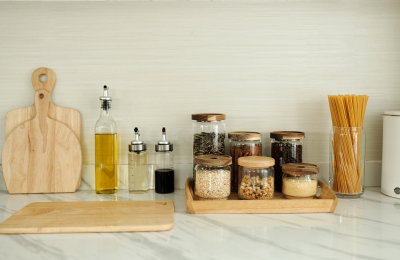
1. Think in zones, not surfaces
A tray instantly turns several loose items into one intentional area.
Candles, remotes, keys or skincare products suddenly feel organised because your eye sees one collection instead of six separate objects.
2. Let your eye breathe
Every shelf doesn't need to be full.
Leaving a little empty space around your favourite objects gives them more impact and instantly creates a calmer feel.
Sometimes the most powerful organising tool is... nothing.
3. Hide everyday clutter
Not everything needs to be on display.
Chargers, pet accessories, reusable bags, paperwork and cleaning products are all useful, but that doesn't mean they need to greet you every time you enter a room.
4. Choose what deserves attention
Our eyes are naturally drawn to colour and contrast.
Instead of displaying everything, highlight the things you genuinely love.
A beautiful vase.
A favourite photograph.
A treasured souvenir.
When everything demands attention, nothing stands out.
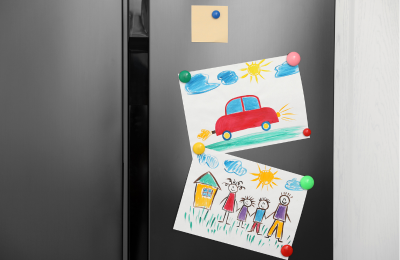
5. Edit your fridge
Fridges have become family noticeboards.
Menus. Invitations. School letters. Shopping lists. Magnets collected over decades.
Try leaving just one or two meaningful items and find another home for the rest.
You'll be amazed how much calmer your kitchen feels.
6. Close the loop
Visual noise often comes from unfinished decisions.
The parcel waiting to be returned.
The paperwork waiting to be filed.
The jumper waiting to go upstairs.
The donation bag that's been sitting in the hallway for weeks.
Completing just one of these tasks removes another little demand on your attention.
Organising isn't about perfection
Professional organisers aren't trying to create homes that look like show homes.
The goal isn't minimalism.
The goal is to create homes that support the people who live in them.
A busy family home will never look like a hotel, and it shouldn't.
But when we reduce unnecessary visual distractions, something interesting happens.
The room feels lighter.
We feel calmer.
Finding things becomes easier.
Our homes begin working with us instead of competing for our attention.
A Profesional Organiser could help you identify and address visual noise in your home. Take a look at our members here.
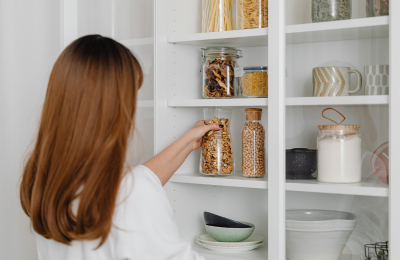
One challenge to try this week
Choose just one room.
Stand in the doorway and ask yourself:
"Where does my eye land first?"
If the answer is a pile of paperwork, a tangle of cables or a worktop full of "I'll deal with it later", start there.
Don't try to organise the whole room.
Simply remove one source of visual noise.
Because sometimes the biggest transformation isn't owning less.
It's giving your mind less to process.