Getting Things Done
I just want to get my holiday booked!
5 minute read
Imagine the scenario… you’ve got an hour to start planning your next holiday. You’ve just sat down when a friend messages asking to meet… You know you’ll forget if you don’t reply right away, so you check your calendar… Then you see a meeting tomorrow and can’t remember the agenda, so you check your email… and there’s an email from school that needs a reply… Suddenly your hour has disappeared – and you’ve not even started thinking about the holiday!
Sound familiar? We’ve probably all had situations like this, being de-railed by unexpected tasks or ‘urgent’ requests. We often try to respond straight away as we don’t trust ourselves to remember later – but then we’ve got a nagging anxiety about all the things that we’re not doing.
Trying to solve this problem is at the heart of David Allen’s ‘Getting Things Done’® – the book about ‘The Art of Stress-Free Productivity’ which describes itself as “a personal productivity methodology that redefines how you approach your life and work”.

So, what does it involve?
The system aims to help us function productively, even if/when we have an overwhelming number of things to do – and to deal with everything from big dreams to the smallest of details, i.e. from ‘tackle climate change’ to ‘buy apples’. The result should be a state of “relaxed control” in which our heads are clear and we always know what we should be doing…
This obviously sounds great – but the reality takes some work. David Allen explains that setting up the system properly can take a few days and it might even take a couple of years to get it fully working. However, even if you’re not ready to embrace it fully, it can still be useful to know about methodologies like this – we can tweak them to fit our own lives or just take a few useful ideas.
Basic principles of GTD®
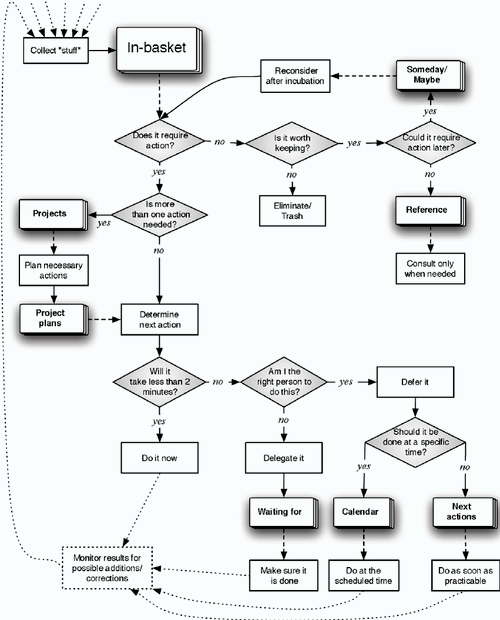
The central concept is that we’re being slowed down by trying to keep too much in our heads, as our minds are intended for thinking and not for ‘storage’. We therefore need to ‘collect’ everything elsewhere – as he believes that these ‘open loops’ (i.e. all the ‘to do’ things that are hanging around in our brains) create anxiety. If we can ‘capture’ all of these and work out how to deal with them then we’ll feel calmer.
So, for each ‘open loop’, we need to decide what to do about it (‘clarify’) – and if it’s actionable then we need to decide what that next action is. We then need to ‘organise’ it to the right place, depending on how urgent it is etc – for instance, a ‘someday/maybe’ list for longer-term ideas and a ‘tickler’ file for reminders on specific days.
We then need to ‘review’ everything regularly (he suggests weekly) to keep the system up-to-date and not miss anything. The final stage is to ‘engage’, i.e. decide what needs to be done when… and do it!
And does it work?
I definitely don’t follow the system fully – and I feel that one of its shortcomings is that he doesn’t really tackle what to do if/when you have more things to do than you have time to do them! However, I’ve incorporated many of his ideas into my own systems. For example, I have an ‘awaiting’ list (one of his suggestions) and link this with the ‘tickler’ idea by putting them on specific dates – so if I haven’t heard by that date then I know to follow up. I also use his idea of ‘context’ lists – so I put tasks relating to one place/person together to all be tackled at once.
Other APDO organisers have adapted it for themselves too – Julia Jamieson (Orka Living) agrees that our minds don’t make great storage systems. She says, “when everything lives in your head, it creates mental noise, overwhelm and that constant feeling of “I’m forgetting something”. I find that getting it all out of my head and into a system I trust is often the first step to feeling calmer and more in control.”
Stephanie Rough (The Organised Zone) uses technology to help with the ‘capture’ process – she often has ideas whilst out walking the dog, so she dictates voice-notes into her phone to listen to later. She explains that a regular review is also vital for making it work, saying, “it’s important to have a reminder to go back through your notes to check you’ve captured all your ideas in your system.”
Is there an easier way?

Even if you don’t implement the full system, there are still many GTD® tips that might be useful…
- Create a system based on your reality, rather than designing it theoretically – if we start by getting our day-to-day tasks under control then that can free us up to think about ‘bigger picture’ stuff (rather than starting by thinking of our ‘purpose’ and working the other way)
- Make systems fun and easy – we’re less likely to stick to anything that’s complicated
- Have a ‘personal purge day’ at least once a year – go through your whole system to get rid of anything that’s out-of-date
- Make ‘next actions’ specific – e.g. ‘compare flight costs’ rather than ‘plan holiday’
- The 2-minute rule – if a task takes under 2 mins then don’t bother to write it down… just do it!
But it won’t work for everyone…
If you’ve tried GTD® (or any other system) and it’s not worked out then remember that ‘no one size fits all’. You’re not doing something wrong: it’s either not the right system for you or maybe it needs some tweaks to suit you better.
If you’d like some support then perhaps an APDO member could help – as well as working with clients on physical organising and decluttering, some APDO members also offer assistance with productivity systems. Just search the ‘Productivity’ specialism on Find An Organiser and we’d love to help you ‘get things done’, create a calmer life… and finally get that holiday booked!